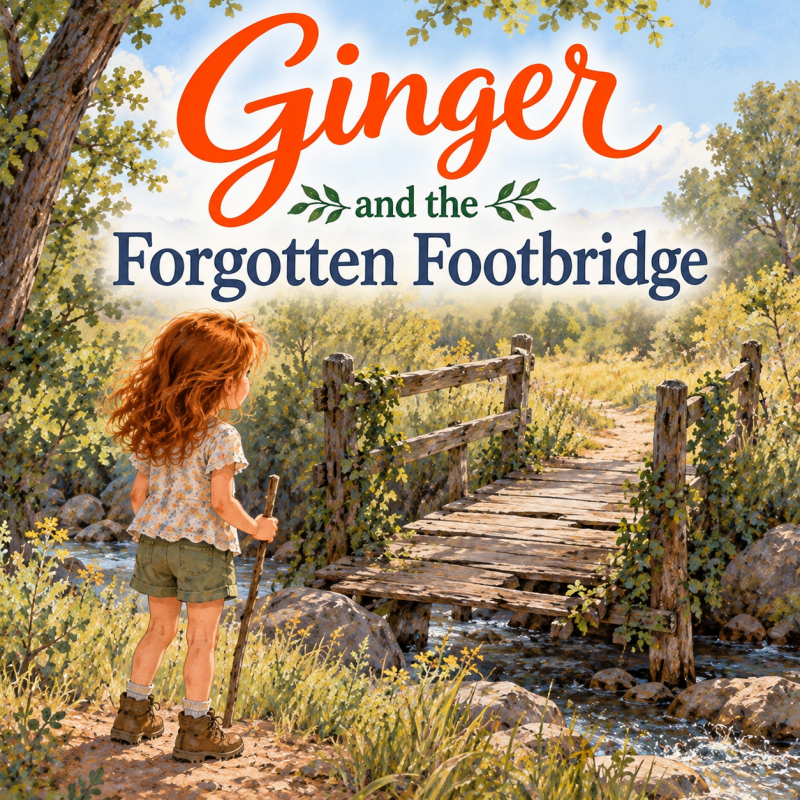
Ginger found the footbridge because she went the wrong way.
She hadn’t meant to. She was following a narrow trail that wandered beside a shallow creek, stopping now and then to poke at interesting things with a stick. The creek wasn’t much of a creek that time of year. Water slipped between smooth stones in thin, sparkling ribbons, and in some places Ginger could step from one bank to the other without getting her shoes wet.
She had been this way before, or at least she thought she had. But when the trail divided beneath a crooked juniper, Ginger chose the path on the left instead of the one on the right. It grew narrower almost immediately. Branches brushed against her shoulders. Tall grass leaned across the trail, and prickly weeds caught at her socks. Ginger considered turning around, but just ahead she could hear water moving faster than it had before.
Then she saw it.
An old wooden footbridge crossed the creek. Ginger stopped. She was certain it hadn’t been there the last time she came this way.
The bridge was barely wide enough for one person. Its boards were gray with age, and one of them had split straight down the middle. A wooden railing remained on one side, but on the other there were only two crooked posts. Vines had grown around the ends of the bridge, almost hiding it from the trail.
Ginger stepped closer. “Well,” she said, “where do you go?” She put one foot on the first board and pressed down.
Creeeeak.
Ginger pulled her foot back. “That wasn’t a very good answer.”
She crouched beside the bridge instead. There were marks on one of the railing posts, three little notches carved into the wood. Farther down were two more. Ginger ran her finger across them. Someone had made those marks.
That changed everything.
This wasn’t just an old bridge nobody used anymore. Once, people had crossed it. Maybe children had run across it. Maybe someone had carried fishing poles over it. Maybe a farmer had walked across every morning. Maybe...
Ginger noticed something else. On the far side of the creek, almost hidden beneath weeds, the trail continued. Now she absolutely had to know where it went.
She tested the first board again, this time with both feet. It creaked but held. The second board felt solid. The third wobbled enough to make Ginger grab the railing. “Okay,” she whispered. “I don’t like you.”
She moved slowly, testing each board before trusting it. Beneath her, the creek suddenly seemed much farther down than it had from the bank, even though Ginger knew perfectly well it wasn’t.
Halfway across, she stopped.
One board was missing.
Through the opening she could see water tumbling over the rocks below. Ginger looked back. Then she looked ahead. The sensible thing would have been to turn around. Ginger was occasionally sensible.
This was not one of those occasions.
She held tightly to the railing, stretched one leg across the gap, planted her shoe on the next board and pulled herself over. The bridge groaned. Ginger froze.
Nothing happened.
She hurried the rest of the way and jumped onto solid ground. “I knew you could do it,” she told the bridge, although she had known no such thing.
The trail on the other side was even harder to see. Ginger pushed through tall grass and ducked beneath a low branch. She hadn’t gone very far when she found a rusted tin cup lying beside a flat stone. Then she found another stone. And another. They formed a line.
Ginger followed them through the weeds until she reached a small clearing. At first she didn’t understand what she was looking at. There were only stones, weeds and a few pieces of weathered wood. Then the shapes began to make sense.
A rectangle of stones marked the foundation of a tiny building. Near it stood the remains of an old fence. A rusted hinge lay in the dirt, and half buried beneath a bush was a round metal basin with a hole in the bottom.
Someone had lived here.
Ginger walked slowly around the clearing. She imagined a little house with smoke curling from its chimney. Maybe chickens had scratched near the fence. Maybe somebody had washed clothes in that metal basin. Maybe children had crossed the footbridge every day.
Then, beneath a flat piece of wood, something caught the sunlight. Ginger knelt and brushed away the dirt.
It was a marble.
Blue glass, cloudy with age.
She held it toward the sky. For a moment, sunlight passed through it and painted a tiny blue circle across her palm. Ginger smiled. She wanted to put the marble in her pocket. Instead, she carried it to the edge of the old stone foundation and set it carefully on top of one of the rocks.
It belonged there.
The shadows were getting longer now, and Ginger knew she should head home. She followed the faint trail back to the creek and stopped when she reached the footbridge. Crossing it the second time wasn’t nearly as frightening.
Well, except for the missing board. And the wobbling one. And the terrible groaning noise near the middle.
“All right,” Ginger admitted when she reached the other side. “You’re a little scary.”
She found the crooked juniper again and took the familiar trail home.
A few days later, Ginger returned. She found the creek. She found the juniper. She found the place where the trail divided.
But the path on the left was gone.
Ginger stared at the wall of grass and brush in front of her. She pushed through it anyway. There was no trail. She searched up and down the creek until her legs were scratched and her socks were full of burrs.
No footbridge. No weathered boards. No three little notches carved into a railing.
Nothing.
Ginger stood beside the creek with her hands on her hips. “That is impossible.”
The creek kept running.
Years later, Ginger would sometimes wonder whether she had simply forgotten exactly where the trail had been. But whenever she remembered the old footbridge, she remembered something else too.
A blue glass marble sitting on a stone in a forgotten clearing, catching the sunlight.
And Ginger was certain she hadn’t imagined that.
Create Your Own Website With Webador