Skip to main content
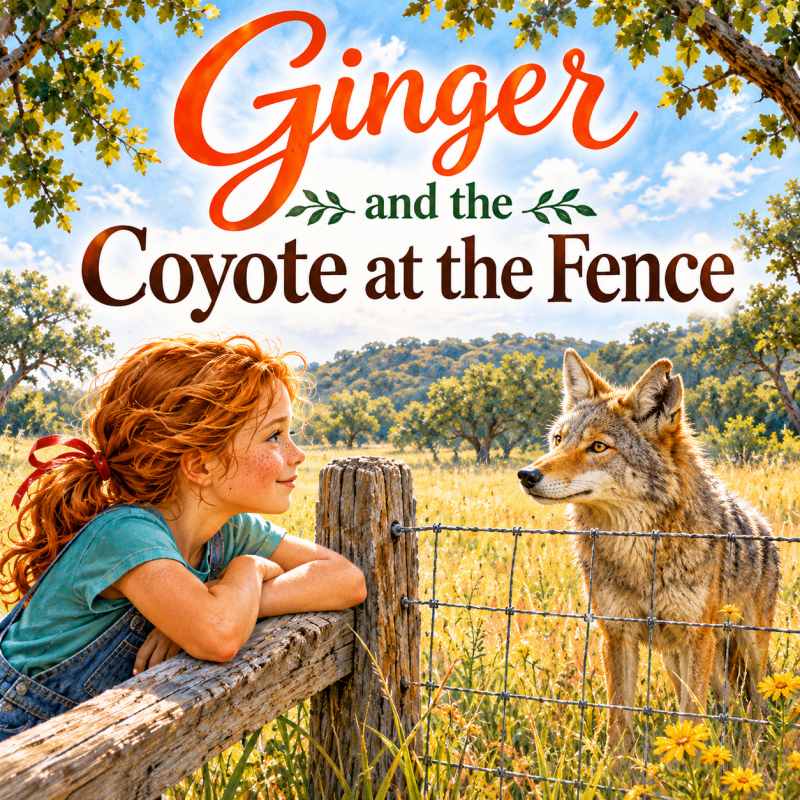
Ginger had seen coyotes before, but always from a distance. Sometimes she heard them yipping and howling in the hills after sunset, their voices rising and falling in the darkness. Other times, she caught a glimpse of one trotting across an empty field, its bushy tail hanging low behind it. But she had never seen one quite as close as the coyote that appeared at the back fence one chilly autumn morning.
She was sitting on the porch steps, pulling on her boots, when she noticed something moving beyond the pasture. At first, she thought it was a dog. The animal was about the right size, with pointed ears and a long, narrow face. But as it stepped into the sunlight, Ginger saw its gray-brown coat, slender legs, and watchful yellow eyes.
A coyote.
It stood perfectly still on the other side of the wire fence, looking toward the house. Ginger stopped pulling on her boot, and for a moment, neither of them moved. Then the coyote tilted its head, as though it were just as curious about Ginger as she was about it.
“Hello,” Ginger whispered.
The coyote's ears twitched.
Ginger had always thought coyotes looked rather clever, as though they knew something nobody else did. This one seemed especially thoughtful. Its fur was thick around its neck, and a dark stripe ran along the top of its tail. One ear had a small notch near the tip, giving it a slightly lopsided appearance. She wondered how it had gotten that way.
The coyote took a few steps along the fence, stopped, and looked back at her. Ginger stood up and watched as it continued walking. She followed along the inside of the fence, keeping a good distance between them.
The animal moved slowly, stopping every few yards to sniff the ground or listen to something she couldn't hear. Once, it lifted its nose into the air and stood motionless for so long that Ginger began to wonder whether it had fallen asleep standing up. Then it suddenly pounced, landing with both front paws in a patch of tall grass as something small darted away beneath the weeds.
Ginger jumped. “Oh! You almost had it!”
The coyote looked up, apparently unconcerned by its failure, and resumed walking. Ginger giggled. She had never imagined that watching a coyote hunt could be so entertaining.
By now, they had reached the far corner of the pasture, where the fence turned toward a shallow ditch lined with rabbitbrush and dry grass. The coyote stopped beside an old wooden post and began sniffing around its base.
Then Ginger noticed something unusual. The coyote wasn't walking quite right. Every few steps, it lifted its left front paw and held it off the ground. When it put the paw down again, it seemed to favor the other leg.
“Are you hurt?” Ginger asked softly.
The coyote glanced toward her, then sat down. Ginger crouched on her side of the fence. She wanted to get a better look, but she remembered what her father had told her about wild animals. They might be beautiful and interesting, but they were not pets, and even a frightened or injured animal could be dangerous. So she stayed where she was.
The coyote bent its head and began licking its paw. Ginger could see something dark caught between its toes, although she couldn't tell what it was.
“Oh, you poor thing.”
She watched for another moment, then turned and hurried toward the house.
“Dad! Dad!”
Her father appeared at the back door, wiping his hands on a dish towel.
“What is it, Ginger?”
“There's a coyote at the fence, and I think something's wrong with its foot!”
Her father followed her across the yard, stopping well before they reached the fence. The coyote was still sitting beside the wooden post, licking its paw.
“See?” Ginger whispered. “It keeps holding that foot up.”
Her father watched carefully. “It does look uncomfortable. But we shouldn't go near it.”
“Can't we help?”
“We can try to find someone who knows how to help wild animals. Sometimes the best thing we can do is give them space.”
Ginger frowned. She didn't particularly like that answer. When something was hurt, she wanted to fix it.
Her father made a phone call to a wildlife rescue organization and described what they had seen. The person on the telephone explained that coyotes sometimes injured their paws while hunting or traveling across rough ground. They advised keeping a safe distance, watching for signs of serious injury, and not attempting to catch or feed the animal.
“But what if it can't walk?” Ginger asked when her father finished the call.
“Then we'll call them again. For now, let's see what it does.”
They watched from the porch for a while. Eventually, the coyote stood, stretched its long legs, and began moving along the fence again. It still limped, but it seemed able to walk. Then, without warning, it slipped beneath a loose section of wire and disappeared into the brush.
Ginger hurried to the corner of the porch, hoping for one last glimpse, but the coyote was gone.
For the rest of the day, she kept looking toward the pasture. She checked the fence after lunch, again before supper, and once more when the evening shadows began stretching across the grass. Nothing.
That night, coyotes called from somewhere beyond the fields. Ginger lay in bed listening to their strange, wavering voices. She wondered whether the coyote with the notched ear was among them.
The next morning, she hurried to the window before she even got dressed. There was no coyote at the fence. Nor the next morning. By the third day, Ginger had begun to worry that she might never see it again. She knew wild animals came and went as they pleased, but she couldn't stop wondering about the injured paw.
On the fourth morning, she was helping her father water the plants when something moved near the far corner of the pasture.
Ginger froze.
There, standing beside the old wooden post, was a familiar gray-brown figure.
“The coyote!” she whispered excitedly.
Her father turned to look. The animal stood with its head raised, watching a pair of ravens circling overhead. Its notched ear pointed forward, and its bushy tail hung behind it.
But what Ginger noticed most was the way it stood.
All four paws were on the ground.
She watched as the coyote trotted a few steps along the fence. There was still a slight hitch in its stride, but it was moving much better than before.
“Dad, look! It's walking!”
Her father smiled. “It certainly seems to be doing better.”
Ginger wanted to clap her hands, but she was afraid of startling it. Instead, she stood very still and watched.
The coyote wandered toward a patch of tall grass, stopped, and listened. Its ears turned this way and that, following sounds Ginger couldn't hear. Then it crouched low, gathered its legs beneath it, and sprang into the air. It landed nose-first in the grass and, a moment later, lifted its head with a small mouse in its mouth.
Ginger's eyes widened.
“Oh!”
The coyote swallowed its catch, licked its nose, and looked toward the fence.
Ginger wrinkled her nose. “Well, I guess everybody has to eat.”
Her father laughed softly. “Even coyotes.”
The animal stood watching them for another moment. Then it turned and trotted toward the open fields, moving with the easy, quiet confidence of something that belonged entirely to the wild. Ginger watched until it disappeared among the bushes.
Over the following weeks, she occasionally spotted the coyote near the far edge of the pasture. Sometimes it traveled alone. Once, she saw it following another coyote across the field, both of them slipping through the tall grass like shadows.
And one evening, just as the sun was setting, she saw the notched-eared coyote standing on a low rise beyond the fence. It lifted its head and gave a long, wavering howl. Almost immediately, another coyote answered from somewhere in the distance. Then another, and another.
Ginger stood on the porch, listening as their voices filled the evening air.
“Dad,” she said, “do you think it's calling its family?”
“Maybe. Coyotes have lots of reasons for calling to one another.”
Ginger smiled. She liked imagining the notched-eared coyote telling the others about its day, or perhaps letting them know where it was.
As the last light faded, the coyote turned and disappeared over the rise. Ginger stayed on the porch a little longer, looking toward the place where it had vanished.
She had never touched the coyote, never fed it, and never gotten close enough to see exactly what had hurt its paw. She didn't even know whether it would return to the fence again. But she had watched it hunt, seen it struggle, worried when it disappeared, and felt wonderfully happy when it came back.
And she had discovered something she hadn't expected. You didn't have to bring a wild animal home to feel connected to it. Sometimes it was enough to watch from a distance and be glad that it was out there, living its own mysterious life.
Just as Ginger turned to go inside, a single coyote called from somewhere beyond the pasture.
She stopped and smiled.
“Goodnight, Notch,” she whispered.
Then she went inside, leaving the wide, dark fields to the coyotes.
Create Your Own Website With Webador