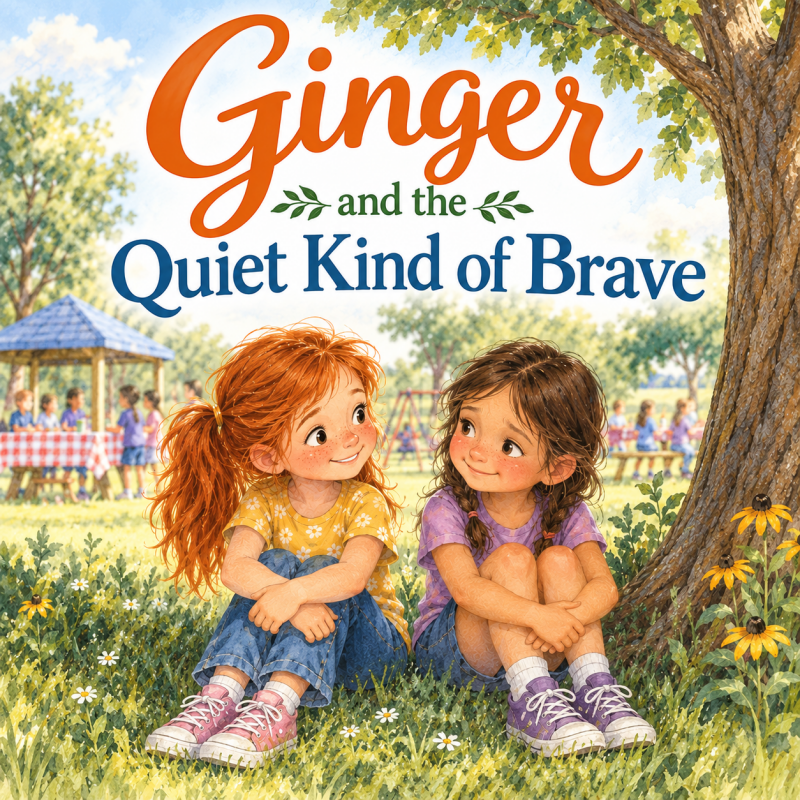
Ginger had always thought brave people were easy to spot. They climbed the highest trees, jumped from the biggest rocks, went into dark places without a flashlight, and picked up bugs that had far too many legs. Brave people rescued kittens, stood in front of barking dogs, and did things that made everyone else say, “Wow!”
Ginger liked the idea of being brave. She just wasn’t sure she was very good at it.
One Saturday afternoon, Ginger went with her mother to a neighborhood picnic at the park. Long tables had been covered with bright paper cloths, and there were bowls of potato salad, plates of sandwiches, slices of watermelon, and more cookies than Ginger thought any group of people could possibly eat.
Children were everywhere. Some raced across the grass, some hung upside down from the monkey bars, and others pumped their legs on the swings until they seemed determined to fly right over the top. A group of older children had started a noisy game near the picnic tables, shouting rules at one another that seemed to change every few minutes.
Ginger didn’t know most of them.
For a while, she stayed close to her mother. She ate a piece of watermelon, wandered as far as the end of the picnic table, and came back. She watched two girls run past laughing together. A boy she had seen at school waved at someone behind her, and Ginger almost waved back before she realized he wasn’t waving at her.
She decided she needed another cookie.
That was when she noticed a little girl sitting alone beneath a tree.
The girl looked about Ginger’s age. She had a paper plate balanced on her knees, but she wasn’t eating anything. Her brown hair was pulled into two crooked braids, and the toe of one sneaker was making little half circles in the dirt. Every now and then she looked toward the other children and then quickly looked back down.
Ginger watched her for a minute.
Maybe the girl wanted to be alone.
Or maybe she didn’t.
Ginger thought about going over to her, but suddenly that seemed much harder than climbing a tree or touching a beetle. What if the girl didn’t want company? What if Ginger said something silly? What if neither of them could think of anything to say and they just sat there staring at their shoes?
Besides, Ginger reasoned, someone else would probably go talk to her.
She waited.
No one did.
Across the park, someone shouted, and a whole group of children burst into laughter. The girl beneath the tree looked up again. This time Ginger saw something in her face that she recognized. It was the look Ginger sometimes had when she wanted very badly to belong somewhere but didn’t know how to begin.
Ginger picked at the edge of her napkin.
She could stay right where she was. Nobody would know the difference.
She glanced at the girl again.
Then Ginger slid down from the picnic bench.
“Where are you going?” her mother asked.
“Over there,” Ginger said.
It wasn’t much of an answer, but it was all she had.
She walked across the grass. Halfway there, she almost turned around. Her stomach felt fluttery, and suddenly she became very interested in a dandelion growing near her shoe. She stopped and looked at it as though she had never seen a dandelion before in her entire life.
Then she peeked toward the tree.
The little girl had noticed her.
Now Ginger definitely couldn’t turn around.
She kept walking.
“Hi,” Ginger said.
“Hi.”
That was it.
Ginger stood there for a moment. The girl looked at her. Ginger looked at the girl. Then they both looked at the ground.
There was a very long silence.
Ginger wished she had planned this better.
Finally, she pointed toward the swings. “I like swinging, but I don’t like going too high.”
The girl looked up. “Me either.”
“My brother says you’re supposed to jump off when you get really high.”
The girl’s eyes grew wide. “I would never do that.”
“Me either,” Ginger said. “I think that’s a terrible idea.”
The girl smiled.
Ginger smiled back.
Her name was Lucy. She had moved into the neighborhood only a week before and didn’t know anybody yet. Her old house had been far enough away that she had to leave her best friend behind, along with the bedroom where she had glow-in-the-dark stars on the ceiling and a backyard with a tire swing.
“I don’t have any friends here yet,” Lucy said quietly.
Ginger thought about that.
“Well,” she said, “you know me now.”
Lucy looked at her and smiled again.
Ginger sat beside her, and for a while they talked about ordinary things—school, dogs, whether raisins belonged in cookies, and why grown-ups always seemed to put onions in food that was perfectly good without them. Lucy hated peas. Ginger hated cooked carrots. They both liked pancakes better than eggs and agreed that bedtime should be at least one hour later on Saturdays.
By then, talking wasn’t hard at all.
A little while later Ginger pointed toward the playground. “Do you want to go swing?”
Lucy hesitated.
“We don’t have to go high.”
“Okay.”
They walked to the swings together and chose two beside each other. At first they barely moved, dragging their shoes through the sand. Then Ginger pushed backward, Lucy followed, and soon they were swinging higher.
Not too high.
Just high enough.
When the older children ran past them shouting about another game, Lucy didn’t look down at her shoes this time. She was laughing because Ginger had just admitted that once, when she was little, she had tried to feed a cracker to a grasshopper.
“I thought it might be hungry!” Ginger protested.
Lucy laughed even harder.
Later, when the picnic was ending and Ginger and her mother were heading home, Ginger looked back. Lucy was standing beside her family near the picnic tables. When she saw Ginger, she waved.
Ginger waved back.
Her mother reached down and squeezed her hand. “That was a kind thing you did.”
Ginger shrugged. “She just needed somebody to talk to.”
What Ginger didn’t say was that walking across that grass had been scary. Not monster scary or thunderstorm scary. Not the kind of scary that made you scream or run.
It was a quieter kind of scary.
The kind nobody else could see.
That night, tucked beneath her blankets, Ginger thought again about brave people. Maybe brave didn’t always look like climbing the highest tree or marching into a dark room. Maybe sometimes nobody clapped. Nobody said, “Wow!” Nobody even noticed.
Sometimes brave was walking across a patch of grass when you wanted to turn around.
Sometimes it was sitting beside someone who was alone.
Sometimes it was saying one small word when you weren’t sure what would happen next.
Hi.
And sometimes, Ginger decided as she closed her eyes, the quiet kind of brave was just enough.
Create Your Own Website With Webador