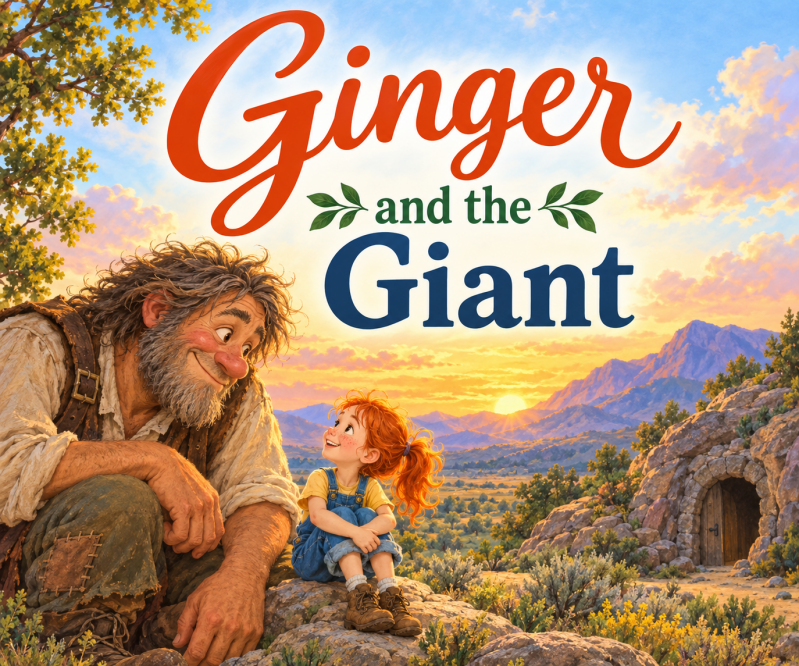
Ginger was supposed to be picking apricots. That was what she had been told to do, anyway. The old apricot tree leaned over the back fence, its branches heavy with fruit, and Ginger had been given a small tin bucket and very clear instructions.
“Only the ripe ones.”
Ginger had picked seven when the ground shook. Not much. Just enough to make three apricots drop from the tree. She looked down at them, puzzled. Then the ground shook again, harder this time, and the bucket tipped over.
Ginger stood perfectly still.
Something was coming.
She hurried to the back gate and peeked through the crack between the boards. Beyond the yard stretched a dry field and then a low ridge of rocky hills. Ginger knew those hills. She had climbed them, searched for lizards among their rocks, and once spent nearly an hour following a shiny green beetle that seemed to know exactly where it was going.
But there was something behind the hills now.
Something enormous.
At first Ginger thought a storm cloud was rising on the other side. Then the cloud moved. A head appeared above the ridge, followed by two shoulders and a chest.
“Oh,” Ginger whispered.
A giant stepped over the ridge.
He was so tall that the tallest juniper barely reached his knees. His trousers were patched at both knees, one boot had no laces, and his wild gray-brown hair stuck out in every direction. A leather bag hung from one shoulder. He took another step, and dust jumped from the ground.
Ginger should have run inside.
Instead, she opened the gate.
The giant stopped. For a moment neither of them moved. Then one enormous eye turned toward Ginger.
“YOU,” the giant said.
His voice rattled the gate.
Ginger swallowed. “Me?”
The giant bent down, closer and closer, until his face filled half the sky.
“You are very small.”
Ginger frowned. “You're very big.”
The giant blinked. Then he laughed. It was a terrible laugh—not because it was mean, but because it was enormous. Birds flew out of bushes, dust blew across the field, and Ginger grabbed the gatepost to keep her balance. When the giant finally stopped, he wiped his eyes with a sleeve.
“I suppose I am.”
“What are you doing here?” Ginger asked.
“Walking.”
“Where?”
The giant straightened and looked toward the horizon. “I don't know.”
Ginger found this interesting. Grown-ups usually pretended they knew where they were going even when they didn't.
The giant reached into his leather bag, and Ginger backed up a little. He pulled out a spoon longer than Ginger was tall. Then came a red sock, a bent frying pan, three books tied together with string, a blue bottle, a wooden whistle, and something that looked suspiciously like half a wagon wheel.
“What are you looking for?” Ginger asked.
“My map.”
“You lost your map?”
“No.” He dug deeper into the bag. “I appear to have lost the place the map was pointing to.”
Ginger stared at him. “That doesn't make any sense.”
“I know.”
The giant sat down with such a thump that Ginger's bucket bounced. He unfolded a crumpled piece of paper and carefully lowered it to the ground. Ginger walked over and climbed onto one corner to keep the wind from blowing it away.
The map was covered with mountains, rivers, forests, and strange little drawings. Near the bottom was a crooked black X.
“There,” said the giant, pointing with a finger almost as long as Ginger's arm. “That's where I'm going.”
Ginger studied the map. She turned it sideways, then upside down, then sideways again.
“Your map is wrong.”
The giant looked offended. “This map is four hundred years old.”
“That's probably why.”
The giant stared at her.
Ginger pointed toward the drawing beside the X. “That's supposed to be a mountain.”
“Yes.”
“But there isn't a mountain there.”
“I noticed.”
“There are houses.”
“I noticed those too.”
“And a road.”
“Yes.”
“And somebody built a gas station.”
The giant sighed. “That was particularly disappointing.”
Ginger sat on the edge of the map. “What are you supposed to find at the X?”
The giant hesitated. “A door.”
“What kind of door?”
“I don't know.”
“Where does it go?”
“I don't know.”
“What's behind it?”
“I don't know.”
Ginger grinned. Now this was getting interesting.
“We should find it.”
The giant raised one eyebrow. “We?”
“Yes.”
“You were picking apricots.”
Ginger looked back at the little tin bucket lying beside the gate.
“That can wait.”
The giant smiled.
Ginger climbed onto his shoulder, and from up there the world was completely different. She could see rooftops, roads, fields, distant mountains, and tiny cars moving like beetles. Her house looked like something from a toy village.
“THIS IS WONDERFUL!” she shouted.
“You don't have to shout,” said the giant. “You're sitting beside my ear.”
“Oh. Sorry.”
They followed the old map across the countryside. They crossed a dry arroyo in one step and passed over fences without opening gates. Once the giant stopped because Ginger spotted something shiny far below, but when he bent down to investigate, it turned out to be an old hubcap.
Finally, Ginger saw something.
“Stop!”
The giant stopped so quickly that Ginger grabbed a handful of his wild hair to keep from sliding off.
“Ow.”
“Sorry.”
Below them was a rocky slope Ginger had passed many times. Half hidden behind scrub and loose stones was something she had never noticed before—a straight line in the rock. Then another. And another.
A rectangle.
The giant carefully lowered Ginger to the ground. Together they pulled away branches, dirt, and loose stones until they uncovered a door set directly into the hillside.
It was enormous.
Even for the giant.
There was no handle and no lock. Nothing was written on it. There was only a small round hole near the bottom.
Ginger knelt beside it.
The hole was exactly the size of her hand.
The giant looked at Ginger.
Ginger looked at the giant.
“No,” he said.
“I didn't say anything.”
“You were about to.”
Ginger smiled and slipped her hand into the hole.
CLICK.
The giant jumped backward.
The door began to open.
Slowly.
Deep inside the hill, something groaned and rumbled. Cold air rushed through the widening crack, carrying the smell of stone and earth. Ginger stepped closer and peered beyond the door into darkness.
Then, very far away, a tiny golden light appeared.
The giant leaned down beside her. “What do you suppose is in there?” he whispered.
Ginger stared into the darkness. “I don't know.”
That was more than enough reason to go in.
The giant had to duck almost double to fit through the doorway, while Ginger walked easily beneath him. The passage smelled of stone and something else now—something warm and sweet that Ginger couldn't quite name.
The golden light grew brighter as they walked. Soon the narrow passage opened into a cavern so enormous that Ginger couldn't see the ceiling.
She stopped.
“Oh.”
Hundreds of little golden lights floated through the cavern. They weren't lanterns. They drifted slowly through the air like fireflies, except each one was as large as an apple.
In the center of the cavern stood a stone table.
And on the table was a box.
The giant hurried toward it. “This is it!”
“You don't know that,” Ginger said, running after him.
“I've been looking for four hundred years. I'm allowed to be excited.”
The box was surprisingly small—small enough for Ginger to carry. There was no lock, only a picture carved into its lid. Ginger brushed away the dust and discovered a giant holding hands with a very small person.
The giant became quiet.
“What does it mean?” Ginger asked.
“I don't know.”
“Well, open it.”
The giant reached for the box and pulled at the lid.
Nothing happened.
He pulled harder.
Still nothing.
Ginger stepped forward. “Let me try.”
The giant moved aside.
Ginger put both hands on the lid.
It opened immediately.
The giant stared at her.
Ginger grinned. “You are very big.”
“I remember.”
Inside the box was a key.
It was the tiniest key Ginger had ever seen.
The giant carefully picked it up between two fingers and frowned at it. “Four hundred years for this?”
Ginger began to laugh.
Soon the giant was laughing too, and their laughter rolled through the cavern until the golden lights danced wildly overhead.
Then one of the lights floated down.
It circled the giant's hand once and touched the tiny key.
The key began to glow.
Somewhere deep inside the mountain came a tremendous sound.
CLICK.
Ginger stopped laughing.
The giant stopped laughing.
They looked at each other.
“That,” Ginger whispered, “was a very big lock.”
For several seconds they waited.
Nothing happened.
Then the floor beneath them trembled.
A crack appeared in the stone wall behind the table. It ran upward, split in two, and spread until the rock itself began moving apart.
Another doorway appeared.
This one was taller than the giant.
Beyond it was not another cavern.
There was a sky.
A deep blue sky filled with stars.
Ginger slowly walked toward it. On the other side stretched a land she had never seen before, mountains with silver tops, trees with pale blue leaves, and hundreds of golden lights drifting through the air.
Far in the distance, enormous shapes moved among the mountains.
Giants.
The giant beside Ginger didn't say anything.
Ginger looked up at him. There were tears in his eyes.
“Is this where you came from?”
“I think so,” he whispered.
“You don't remember?”
The giant shook his head. “Four hundred years is a very long time.”
Ginger thought about that.
Then she slipped her small hand around one of his enormous fingers.
The giant looked down at her and smiled.
For a while they stood together at the doorway.
Finally, the giant tucked the tiny key carefully into his pocket.
“I think I have to go.”
Ginger didn't particularly like that part.
“You just got here.”
“I know.”
“Will you come back?”
The giant looked through the doorway at the strange mountains and the other giants moving in the distance.
“I don't know.”
Ginger frowned.
The giant smiled. “You ask very difficult questions for someone so small.”
“You give very bad answers for someone so big.”
The giant laughed again, but softly this time.
He lifted Ginger onto his shoulder and carried her back through the dark passage, past the floating golden lights, through the enormous stone door, and out into the evening.
The sun was sinking behind the hills.
He lowered Ginger beside the path.
“Thank you,” he said.
“For what?”
“For finding the place my map was pointing to.”
“I mostly told you your map was wrong.”
“That helped.”
Ginger considered this and decided he was probably right.
The giant turned toward the hidden door.
“Wait!”
He looked back.
Ginger ran to him and wrapped both arms around one of his fingers. It was the best hug she could manage.
The giant gently touched the top of her head.
Then he disappeared into the hillside.
The great stone door slowly closed behind him until it looked like nothing more than an ordinary rocky slope.
Ginger stood there for a while.
Then she noticed something lying on the ground.
The old map.
She picked it up.
The crooked black X was gone.
Ginger smiled and folded the map carefully before tucking it under her arm.
By the time she reached home, the first stars had appeared. The little tin bucket still lay beside the gate, and the seven apricots were scattered beneath the tree exactly where she had left them.
Ginger picked them up one by one.
Then she noticed something strange.
There were eight.
Ginger held the last apricot in her hand.
It was much larger than the others.
Much, much larger.
She looked toward the distant hills.
For just a moment, Ginger thought she heard laughter rolling across the desert.
She smiled.
Then she put the enormous apricot in the bucket.
And tomorrow, apparently, she had another giant-sized problem to solve.
Create Your Own Website With Webador