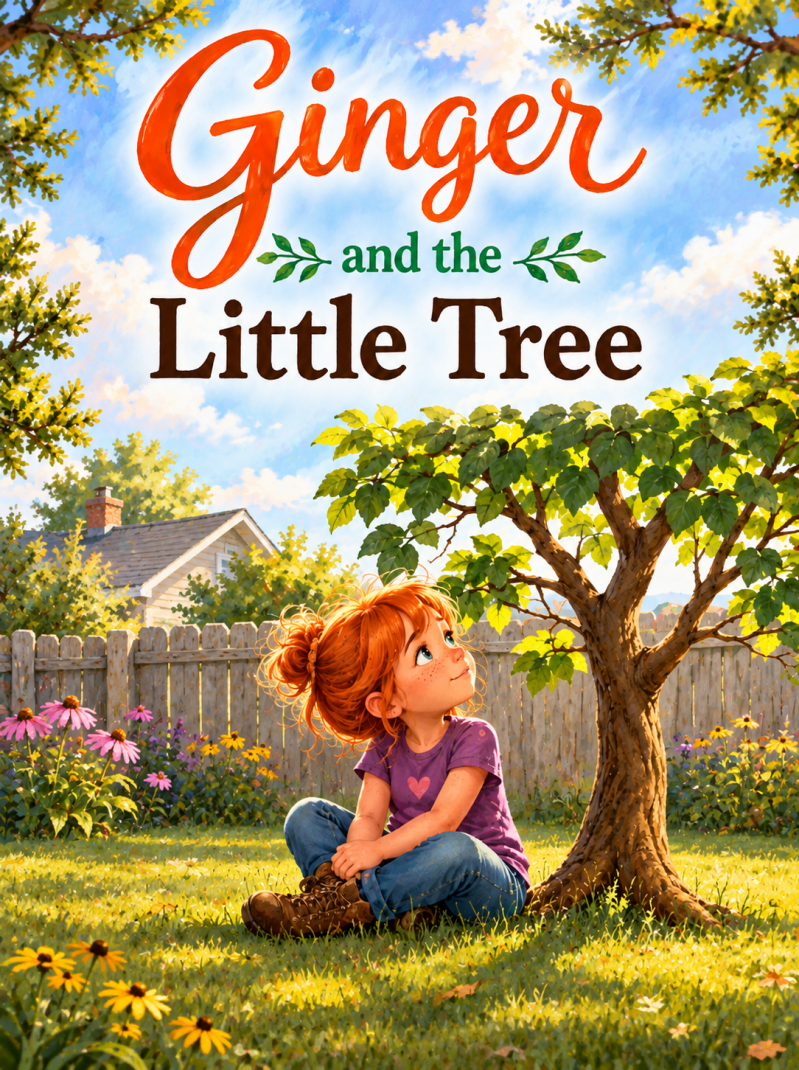
At the far end of Ginger’s backyard, just beyond the flower garden, stood a little tree. It wasn’t much taller than Ginger herself, with a thin trunk, crooked branches, and leaves that fluttered whenever the wind blew.
Ginger had watched her father plant it in the spring. He had dug a deep hole, carefully spread its roots, and filled the earth around it. Then he handed Ginger a small watering can. “This one is yours to look after,” he told her.
Ginger took her responsibility seriously. Every few days, she carried water to the little tree, pulled weeds from around its trunk, and checked for new leaves. Sometimes she sat beside it and told it things she didn’t tell anyone else.
By summer, the little tree had grown a little taller. Its leaves were bright green, and two new branches had appeared near the top. Ginger was certain it was growing faster because she talked to it. One afternoon, she stretched her arms toward its highest branch. “Pretty soon,” she told it, “you’ll be big enough for me to climb.”
But summer never stays as long as children wish it would.
One September morning, Ginger noticed something strange. A leaf near the top of her tree had turned yellow. Not the bright yellow of a sunflower, but the soft golden yellow of morning sunlight. She examined it carefully. “Are you sick?” she whispered.
The next day, three more leaves had changed. By the end of the week, the little tree was wearing patches of gold and orange among its green leaves. Ginger ran to find her father. “Something’s happening to my tree!”
Her father followed her into the backyard and looked up through the branches. “Looks like autumn has found it,” he said.
“But why is it changing?”
“Because the days are getting shorter and the nights are getting cooler. Some trees lose their leaves so they can rest through winter.”
Ginger frowned. “I don't think it wants to lose them.”
Her father smiled. “I don't suppose it gets much choice.”
That bothered Ginger. She thought everyone ought to have a choice about something as important as losing all their leaves.
Over the next few weeks, the little tree changed completely. Its branches glowed with yellow, orange, and a little bit of red. Ginger thought it was the prettiest tree in the whole neighborhood, even though it was probably the smallest.
Then came the wind. It arrived one chilly afternoon, rushing across the yard and rattling the garden gate. Ginger watched from the kitchen window as the little tree bent and shivered. Its beautiful leaves broke loose, spinning through the air like tiny scraps of colored paper.
“Stop!” Ginger cried, hurrying outside. “Those are its leaves!”
She chased them across the grass, catching some in her hands and gathering others from beneath the fence. By the time the wind settled, she had filled both pockets of her jacket. But the little tree looked terribly bare. Only a few stubborn leaves remained, clinging to the ends of its branches.
Ginger stood beneath it for a long time. “I tried,” she said quietly.
The next morning, she brought a small blanket outside and wrapped it around the tree’s trunk. She tied it with a piece of string, being careful not to pull too tightly. “There,” she said. “Now you won't be cold.”
Her father discovered the blanket that afternoon. “What's all this?”
“It's for winter,” Ginger explained. “It doesn't have any leaves to keep it warm.”
Her father knelt beside her. “The tree doesn't need a blanket, sweetheart. Its bark helps protect it, and its roots are safe beneath the ground.”
“But it looks so lonely.”
He glanced at the little tree. “Sometimes things look empty when they're really just resting.”
Ginger wasn't entirely convinced. She left the blanket there anyway, at least until the first snow.
Winter came slowly that year. The flowers disappeared, the grass turned brown, and the mornings grew cold enough to make Ginger's breath look like little clouds. One December morning, she woke to find snow covering the backyard. The little tree stood beneath a white cap, its crooked branches holding tiny piles of snow.
Ginger hurried outside in her boots and winter coat. She brushed the snow from one branch and examined the bare wood. Nothing. No leaves. No flowers. Not even the tiniest bit of green. She wondered whether her tree would ever look alive again.
For weeks, she hardly visited it. There wasn't much to see, and the cold made her fingers ache. Sometimes she glanced toward it from her bedroom window, but it always looked the same.
Then, one morning in March, Ginger went outside to look for the first signs of spring. The flower garden was still mostly brown, but a few green shoots had pushed through the earth. A robin hopped along the fence, tugging at something in the grass.
Ginger wandered toward her little tree. At first, she didn't notice anything different. Its branches were still bare, and the blanket had long since been put away. Then something caught her eye. At the very tip of one branch was a tiny bump.
She leaned closer. There were more of them, little brown buds tucked along the branches, so small she might have missed them if she hadn't been looking carefully.
“Dad!” she shouted. “Come quick!”
Her father came out onto the porch. “What's happened?”
“My tree has bumps!”
He laughed and walked over to see. “Those are buds, Ginger. New leaves are getting ready to grow.”
She touched one gently with the tip of her finger. “Were they there all winter?”
“The tree was getting ready for them, even when you couldn't see anything happening.”
Ginger looked at the bare branches with new interest. Every morning after that, she checked the buds. At first, they seemed determined to stay exactly as they were. Ginger grew impatient and wondered whether she could help them open.
She tried breathing warm air on one. She tried singing to another. Once, she even whispered, “Hurry up,” into a particularly stubborn bud. Nothing happened.
Then, after a night of gentle rain, Ginger went outside and found that one of the buds had opened. A tiny green leaf, wrinkled and folded like a miniature fan, had appeared. Ginger gasped.
By the following week, there were dozens. Little green leaves unfolded along every branch, growing larger and brighter each day. And one warm April afternoon, Ginger noticed something else. The highest branch was now well above her head.
She stood on her toes and reached as far as she could, but her fingers barely brushed its lowest leaves. “You grew!” she exclaimed.
She hurried into the house and returned with her father and a measuring tape. Together, they measured the tree from the ground to its highest branch. It had grown nearly a foot since the previous spring.
Ginger was delighted. All winter, while she had been worrying about its empty branches, the little tree had been alive beneath its bark, waiting for warmer days.
That evening, Ginger sat beside it as the sun dropped behind the rooftops. A breeze moved through the new leaves, making a soft rustling sound. She looked up at the branches and smiled.
“You know,” she told the tree, “I think I like you in every season.”
A little green leaf drifted down and landed in her lap. Ginger picked it up, surprised. She turned it over in her hand, wondering why a brand-new leaf had already fallen. Then she tucked it into her pocket. She would save it with the golden leaves she had collected in autumn.
And next year, when the leaves began changing colors again, Ginger wouldn't be quite so worried. She might even let the wind have a few.
But not all of them.
After all, a girl was allowed to keep a little bit of autumn for herself.
Create Your Own Website With Webador